There is something rather extraordinary happening in the world around us.
We are teaching machines to recognise our faces, imitate our voices, compose our music and reconstruct our memories. We have placed our conversations in the cloud, our identities in databases and increasingly our decisions in the hands of algorithms that seem to know us better than we know ourselves. Artificial intelligence is finding its way into almost every corner of our existence, while the boundaries between the physical and digital worlds are becoming increasingly difficult to distinguish.
We have become remarkably good at translating the world into information, at capturing what we see, recording what we hear and measuring almost everything that can be measured. Even our most intimate experiences are gradually finding their way into systems designed to remember, interpret and predict us. And somewhere in the middle of all this extraordinary progress, a rather old human ritual continues to take place, almost unnoticed. Someone opens a small bottle of perfume.
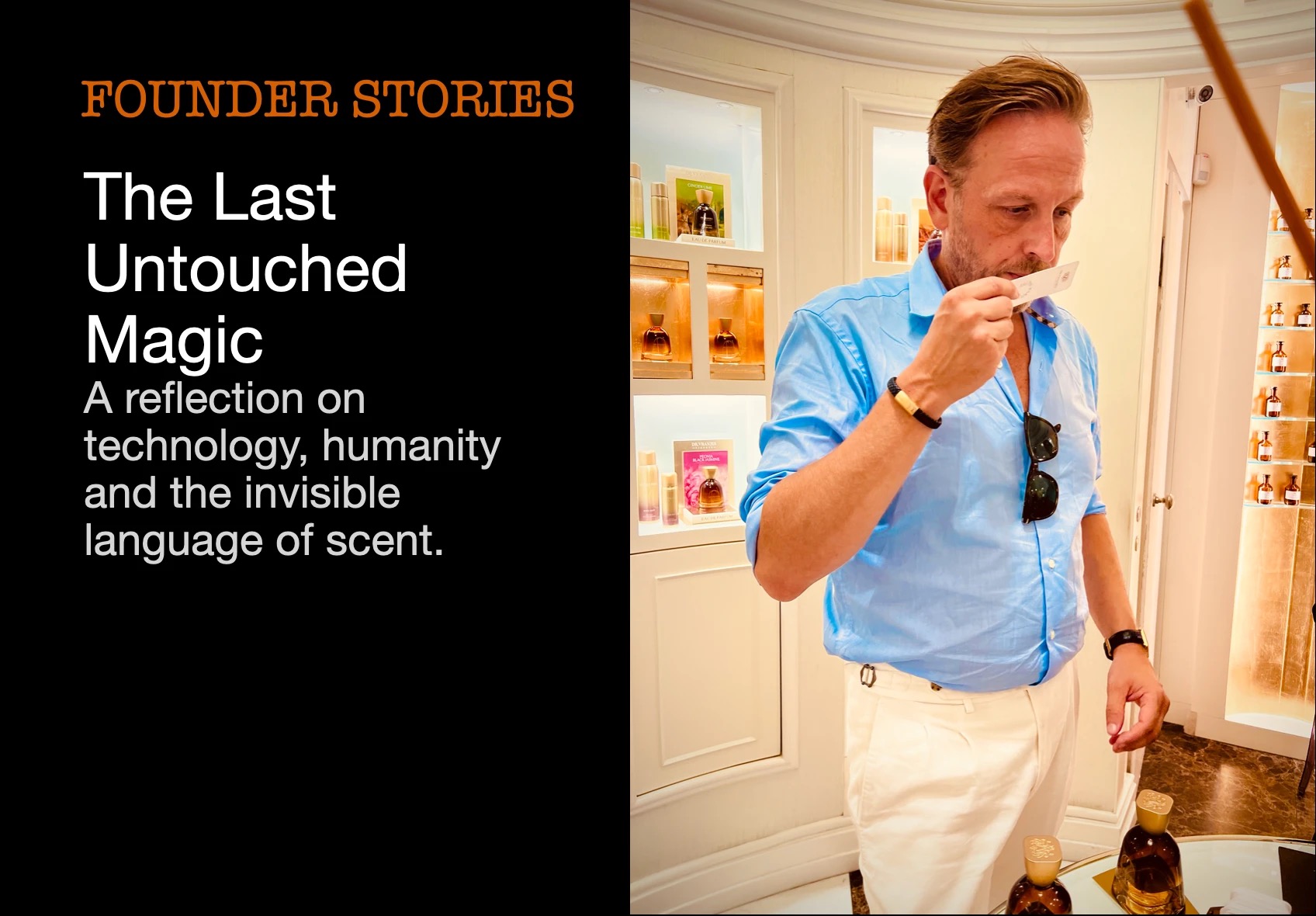
A hand moves towards the neck, a familiar fragrance rises into the air, and for a brief moment something happens that no screen can reproduce and no algorithm can entirely anticipate. Perhaps it is the memory of a summer afternoon in the south of France, the smell of a garden after rain, the interior of a house that no longer exists, or the presence of someone whose absence has become part of our lives. A moment that seemed to have disappeared returns without warning, carried not by an image or a melody, but by something invisible that travels through the air and finds its way into the deepest corners of our memory. It is curious that one of the most powerful instruments of human recollection is also one of the least visible.
We can photograph a landscape, record a voice and preserve a thousand conversations, yet the particular fragrance of a childhood home may remain somewhere beyond the reach of all our archives, waiting patiently for the moment when a familiar scent brings it back to life. We may spend years without thinking of a particular person or place, only to discover that a single breath can restore an entire world that we had almost forgotten.
This is because scent has never really belonged to the world of information in the way that images, words and sounds do. It belongs to the world of experience, where perception and memory meet before language has had the opportunity to intervene, where something can touch us without first asking for our attention or requiring us to understand why.
The perfumer works with molecules, proportions, materials and an extraordinary knowledge of composition, but the experience that eventually emerges from the fragrance belongs to someone else entirely. It takes shape in the encounter between the composition, the individual, the surrounding atmosphere and a particular moment in time, producing an emotional response that cannot be prescribed in advance, even by the person who created the fragrance.
There is something almost poetic about this independence of experience, because while we have become increasingly accustomed to systems that anticipate our preferences and attempt to shape our behaviour, a fragrance remains wonderfully indifferent to our intentions. It does not know our history, recognise our identity or require access to our personal information, and yet it may awaken something within us that no sophisticated digital system could have deliberately summoned.
We can analyse the chemistry of a fragrance, map the neurological pathways involved in olfactory perception and investigate the remarkable relationship between the sense of smell, emotion and memory, but the scientific explanation of a mechanism does not necessarily diminish the mystery of what happens when it becomes part of a human life. We understand the physical composition of a sunset without ever being able to calculate precisely why one particular evening should remain with us for the rest of our lives, just as we can identify the ingredients of a perfume without knowing what memories it will awaken in the person who encounters it.
This is what makes fragrance such a fascinating expression of emergent experience, because its meaning does not reside exclusively in the bottle, the ingredients or the intentions of the perfumer, but arises somewhere between the invisible composition and the equally invisible world of human consciousness.
For thousands of years, people have understood this intuitively, using fragrant woods, flowers, resins and precious oils to mark the important passages of life, to welcome strangers, honour the departed, create sacred spaces and accompany the quiet rituals of everyday existence. Civilisations have risen and disappeared, empires have changed their borders, languages have evolved and technologies have transformed the way we live, yet the human desire to surround ourselves with fragrance has survived almost unchanged.
Today, we may carry the entirety of human knowledge in a device that fits into our pocket, while the most extraordinary memories can still be awakened by something as simple as the scent of a flower, a piece of wood or a few drops of perfume resting on the skin.
There is a lesson hidden in that contrast.
We have spent much of our recent history trying to make everything faster, more accessible, more measurable and more efficient, gradually transforming the world into something that can be processed, optimised and reproduced. Yet the experiences that give our lives their particular richness rarely submit themselves so easily to those ambitions, because affection, nostalgia, anticipation and belonging are not simply functions that can be switched on or off, but emerge from the countless encounters between our senses, our memories and the world around us.
A fragrance cannot promise to make us happier, nor can it guarantee that we will remember a particular afternoon or fall in love with a particular place, but it can create the conditions in which something unexpected may happen, leaving us with an experience that is entirely our own and that no algorithm needs to approve.
In a world increasingly concerned with artificial intelligence, digital identity, cybersecurity and the question of who controls the systems on which we depend, perhaps we should occasionally return our attention to those things that have never required a password, an update or an internet connection to remind us that we are human.
There is a quiet beauty in the fact that we still begin our mornings by opening a small bottle, applying a fragrance to our skin and carrying its invisible presence into the day ahead, participating in a ritual that connects us with generations of people who did precisely the same thing long before the arrival of electricity, computers or artificial intelligence.
The bottle may be contemporary, the composition may be entirely new and the perfumer may have spent years refining every detail, but the essential encounter remains wonderfully ancient, taking place somewhere between the physical world and the private universe of human memory.
That is where the real magic of fragrance resides, not in its ability to transport us somewhere else, but in its ability to reveal something that was already within us, waiting for the right moment, the right atmosphere and the almost imperceptible arrival of a familiar scent.
And while the world continues to invent increasingly intelligent ways of understanding, predicting and influencing human behaviour, there is something reassuring about an experience that asks for nothing more than our presence, that cannot be fully translated into information and that remains, in its most intimate expression, beyond the reach of the digital world.
I think the future of humanity will not be defined solely by how intelligent our machines become, but also by our ability to preserve those experiences that remind us why intelligence, progress and technology matter in the first place.
After all, we may eventually teach machines to reproduce almost everything that we can see, hear or describe, but there will always be something rather extraordinary about a fragrance that rises quietly into the air, finds its way into a human heart and brings an entire forgotten world back to life.
Some forms of magic do not need to be invented. They only need to be remembered.