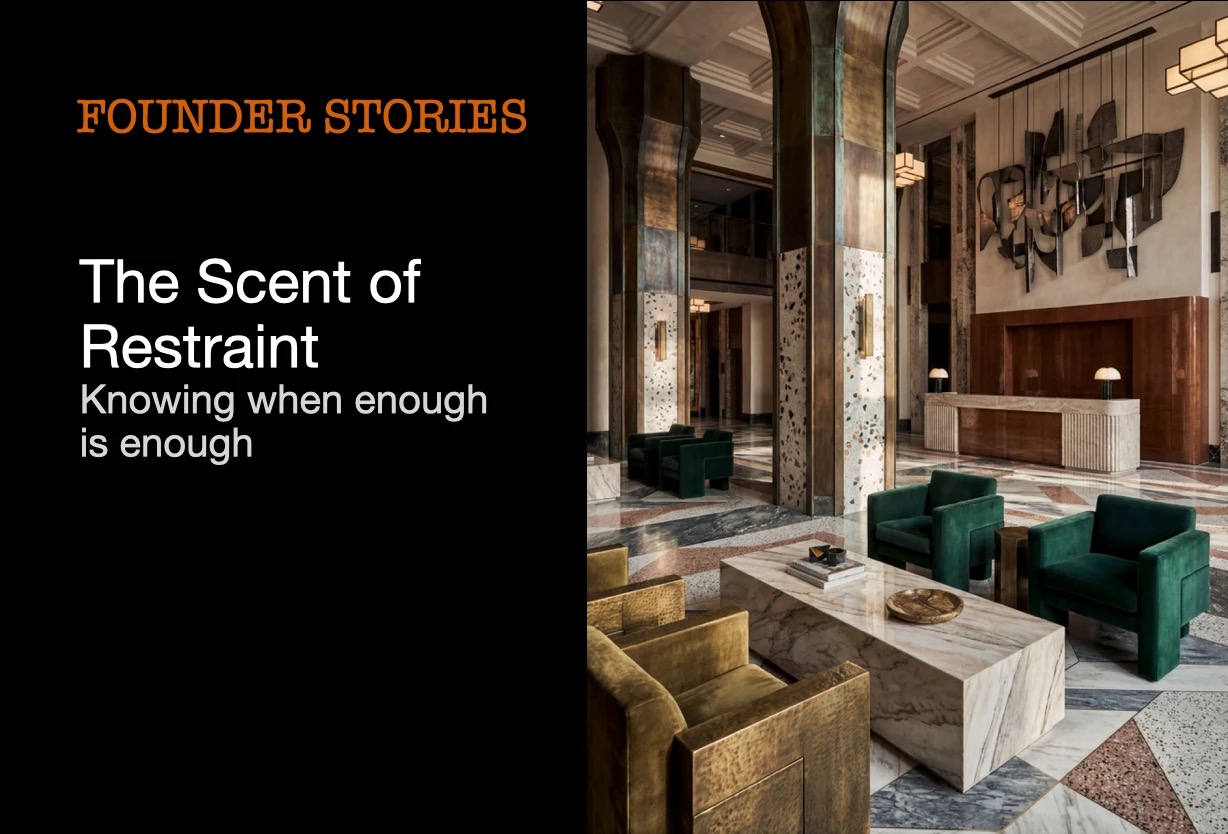
Imagine arriving at a beautiful hotel after a long journey, looking forward to leaving the outside world behind as you step into an environment where every detail appears to have been carefully considered. The architecture is impressive, the entrance welcoming, and the combination of natural stone, thoughtfully selected materials and warm lighting creates an atmosphere of quiet sophistication. Someone opens the door, you step inside, and for a moment everything seems exactly as it should be.
Then you notice the fragrance.
A powerful, unmistakable scent fills the lobby, perhaps an elaborate floral composition or an abundance of white musk and amber, carefully selected to communicate luxury and exclusivity. Whatever its composition, the fragrance announces itself before you have had the opportunity to take in the architecture, exchange a word with reception or form your own impression of the place. It may be pleasant, perhaps even beautifully composed, yet its intensity makes it impossible to ignore, immediately becoming part of your experience whether you intended it to be or not.
This raises an interesting question for the hospitality industry, particularly at a time when hotels are investing more thoughtfully than ever in the sensory dimensions of their guest experience: when does an attempt to create a memorable impression become an experience that a guest would rather escape?
The pursuit of a distinctive guest experience has encouraged hotels to look beyond the traditional elements of hospitality, recognising that architecture, lighting, sound, materials, temperature and fragrance can all influence the way a property is perceived. A signature scent offers an especially intriguing possibility because it can help establish an association with a place that guests may recognise, remember and perhaps recall long after their stay has ended. From a commercial perspective, the reasoning is understandable, as hotels compete not only on location, price and service but also on the memories they create, and a carefully designed sensory identity can help distinguish a property in an increasingly competitive market.
Yet somewhere between the intention and the execution, an important distinction can easily be overlooked: a fragrance that is memorable is not necessarily one that improves the experience.
The science is more interesting than the marketing
Research into the role of ambient scent in hospitality offers a more nuanced picture than either enthusiastic advocates or sceptics might suggest, with a growing body of evidence indicating that fragrance can influence the way people perceive and experience their surroundings, although the extent of that influence depends on the circumstances in which the scent is introduced.
A meta-analysis published in 2024 examined 55 research articles comprising 102 effect sizes and found that pleasant ambient scents generally had positive effects on consumer responses in both retail and hospitality settings, with some cognitive and behavioural effects appearing stronger in hospitality environments. The findings nevertheless varied according to research design, setting and location, suggesting that scent can be more than a decorative addition to an interior, but that its contribution cannot be separated from the context in which it is experienced.
Other research has explored the relationship between fragrance and brand identity, including a study published in the International Journal of Contemporary Hospitality Management that found more favourable consumer responses when a fragrance was perceived as consistent with the brand's image than when it appeared mismatched. Within the setting examined, the findings also indicated improvements in guest satisfaction, intention to revisit and perceptions of products and services, reinforcing the idea that the success of a fragrance depends not merely on its intrinsic appeal but also on how convincingly it belongs to the environment in which it is encountered.
A light, green composition, for example, might feel entirely appropriate in a contemporary retreat surrounded by nature, while the same fragrance could seem anonymous or out of place in a historic property whose identity is built around warmth, heritage and craftsmanship. Conversely, a rich and enveloping scent might complement one environment beautifully while overwhelming another, which is why the relevant question is not simply whether a fragrance smells wonderful in isolation, but whether it makes sense within the character and purpose of the property.
Even when the fragrance itself is well chosen, however, another variable remains equally important: its intensity.
When the guest becomes the afterthought
The more complicated questions emerge when we consider the people who actually experience these environments, because research into hotel scent experiences suggests that guests do not respond uniformly to fragranced spaces. Work discussed by researchers at Hong Kong Polytechnic University, for example, found that many participants responded positively to hotel scents, describing them as strong, refreshing or intense, while some associated the fragrance with pleasant memories of previous hotel stays. Other participants, however, found the intensity off-putting, with some reporting headaches and guests with allergies expressing objections to the growing use of fragrance in hotels.
Preferences also differed according to location, as public areas such as lobbies and corridors were generally viewed more favourably than guest rooms, restaurants and function spaces, where continuously diffused fragrance could become intrusive. These findings do not establish that hotel fragrance is inherently harmful, nor do they imply that every guest will react in the same way, but they do challenge the assumption that a single fragrance delivered at a uniform intensity will produce a universally positive experience.
The objections themselves are not difficult to understand, since a fragrance may simply be too strong, linger longer than necessary or follow a guest from one part of the hotel into another, eventually competing with the smell of food in a restaurant or becoming difficult to escape in a relatively enclosed room. For some people, exposure to strong fragrances is associated with headaches or other discomfort, while for others the objection is more straightforward: they do not necessarily want their surroundings to smell strongly of something they have not chosen.
This brings us to the question of personal space, which deserves particular attention in hospitality because the expectations associated with a shared public environment are fundamentally different from those associated with a private room. A guest may appreciate a distinctive fragrance at the entrance to a hotel, where it contributes to the first impression and helps establish the character of the property, while preferring not to encounter that same fragrance continuously in a guest room, where privacy, comfort and rest become more important considerations.
The lobby is a shared environment designed, among other things, to make an impression, whereas the guest room is a personal environment intended to offer comfort and a degree of control over one's surroundings; given these differences, it is worth asking why their olfactory treatment should necessarily be identical.
Hospitality has always depended on anticipating needs that guests do not always articulate, which is why we pay attention to room temperature, acoustic comfort, lighting and the quality of a mattress, recognising that these details can determine whether a guest feels comfortable, sleeps well and wakes refreshed. Fragrance deserves the same degree of consideration, meaning that it is not enough to ask whether guests like a particular scent; we must also consider whether they want to encounter it in that particular location, at that intensity and for that length of time.
The distinction between offering an experience and imposing one is therefore more than a technical consideration, because it touches on the very essence of hospitality: understanding that the quality of an experience depends not only on what we provide, but also on how thoughtfully we provide it.
The wrong smell is a different problem
Another mistake worth avoiding is the assumption that fragrance can serve as a universal solution to unpleasant odours, particularly when the underlying problem has more to do with cleaning, maintenance, ventilation or the general condition of the building than with the absence of a pleasant scent.
A hotel may struggle with stale air, dampness, smoke, bathroom odours or an inadequately maintained ventilation system, but introducing perfume into such an environment does not remove the source of the problem, even if it temporarily changes the impression the room creates. In some circumstances, combining an existing unpleasant smell with a strong fragrance can produce an even less agreeable result, leaving the guest with the impression that one smell has simply been added to another rather than that the environment has genuinely improved.
The more sensible approach is to identify and address the source of the unpleasant odour before considering whether a deliberately designed fragrance could contribute something meaningful to the environment. This distinction matters because scent design should never be used to conceal a failure in the basic conditions of hospitality, where cleanliness, comfort and fresh air remain fundamental requirements upon which any additional sensory experience must be built.
When these foundations are overlooked, fragrance risks becoming a distraction rather than an enhancement, diminishing the very experience it was intended to improve.
The luxury of proportion
At Maison Stravers, this tension is particularly interesting because it reveals something broader about the nature of luxury, which is rarely a matter of adding as much as possible and more often a question of understanding what belongs, what contributes and what can be left out.
A beautifully designed interior does not require every material to compete for attention, just as a carefully composed meal does not need every ingredient to dominate the palate and exceptional service does not require a member of staff to announce every thoughtful gesture. The same principle applies to fragrance, which should complement the architecture, materials, lighting, food and people occupying a space rather than compete with them, contributing to the combined effect in a way that feels natural to the environment instead of presenting itself as an independent attraction.
Achieving this requires considerably more thought than selecting a fragrance from a catalogue and adjusting a diffuser until the room smells noticeably different, because the process should begin with an understanding of the property itself. What does the hotel stand for, what kind of experience is it trying to create, and is its character contemporary or traditional, restrained or expressive, urban or closely connected to its natural surroundings? Equally important is the question of what a guest should feel upon entering and where, along the guest journey, fragrance could genuinely reinforce that feeling.
Only after these questions have been considered does it make sense to discuss the fragrance itself, followed by the equally important decisions about its application, since a spacious lobby, a narrow corridor, a restaurant and a private guest room each have different physical characteristics and different expectations associated with their use. An approach that works well in one space will not necessarily produce the same result in another, which means that intensity, placement, duration and the ability to adjust or discontinue the fragrance must be considered as integral elements of the design rather than details to be addressed afterwards.
In certain spaces, a subtle background fragrance may help establish a coherent atmosphere, while in others the more appropriate decision may be to leave the air unfragranced altogether. Guest rooms provide a particularly clear example of why personal choice deserves consideration, since it cannot simply be assumed that every guest wants the same sensory experience or that a fragrance which works well in the lobby should also be present in the place where they sleep.
Restraint, in this context, is not a compromise but a deliberate design decision, reflecting the understanding that the quality of a sensory experience depends as much on judgement and proportion as it does on the fragrance itself.
From a signature scent to a coherent experience
The idea of a signature scent remains compelling because a carefully selected fragrance can become part of a hotel's identity, reinforcing the associations guests form with a place and contributing to a coherent experience when it is consistent with the brand and applied thoughtfully. Coherence, however, should not be confused with uniformity, because a hotel's identity can remain recognisable even when its sensory expression changes according to the purpose and character of each environment.
The entrance may call for a distinctive first impression, while a corridor may require considerably less intensity and a private room may benefit from giving the guest control over whether fragrance is present at all. The objective is therefore not to make every part of the building smell identical, but to ensure that every part of the experience feels as though it belongs to the same place, creating continuity without sacrificing the particular needs of individual spaces.
This is a more sophisticated ambition than simply making a hotel smell luxurious, and it requires us to begin with a different question: what would make this particular hotel feel unmistakably itself? The answer may involve fragrance, but it will almost certainly involve much more than fragrance alone, because the contribution of scent should ultimately be judged by how well it supports the experience around it rather than by how strongly it announces its presence.
The most successful scent may be the one you never consciously notice
There is an intriguing paradox in the way we think about fragrance, because we often speak about it in terms of recognition, wanting guests to notice a scent, remember it and associate it with a particular property, while the most sophisticated use of fragrance may sometimes be precisely the kind that does not demand conscious attention.
Imagine entering a hotel and immediately feeling at ease, with lighting, materials, temperature and acoustics working together to create an environment in which the welcome feels natural and nothing appears to compete unnecessarily for your attention. Perhaps a subtle fragrance contributes to that impression, reinforcing the character of the property in a way that is difficult to separate from the wider experience, even if you never consciously identify the scent, remember its individual notes or describe its composition.
You may simply remember that the hotel felt right, which is an interesting measure of success for a discipline so often associated with making a distinct sensory impression. It suggests that fragrance does not always need to become the subject of the experience, because its role can sometimes be to help everything else come together in a way that feels coherent, considered and natural.
That is how we approach the subject at Maison Stravers, where we see scent not merely as a product to be diffused but as a considered element of identity and atmosphere, with particular attention to the relationship between fragrance, environment and the person experiencing it. Our objective is not to make a property smell more strongly of luxury, but to understand what makes that property distinctive and determine whether fragrance can contribute to its character in a thoughtful and proportionate way.
Sometimes this means creating a recognisable signature scent, while in other circumstances it means adapting the experience to the purpose of a particular space or recognising that less fragrance, or no fragrance at all, would be the better decision. The measure of a successful sensory experience is therefore not how much of it we can detect, but what it contributes to the whole.
A hotel may invest in extraordinary architecture, exquisite materials and impeccable service, with fragrance offering another dimension to that experience when it is treated with the same care and judgement as every other element of the environment. The ambition should not be to make a hotel impossible to forget because of how strongly it smells, but to create an experience people remember because everything felt right.
That is the difference between fragrance as an intervention and fragrance as part of a carefully considered identity, and perhaps it is also where the real luxury lies: not in making your presence felt at every moment, but in understanding precisely when your presence is enough.